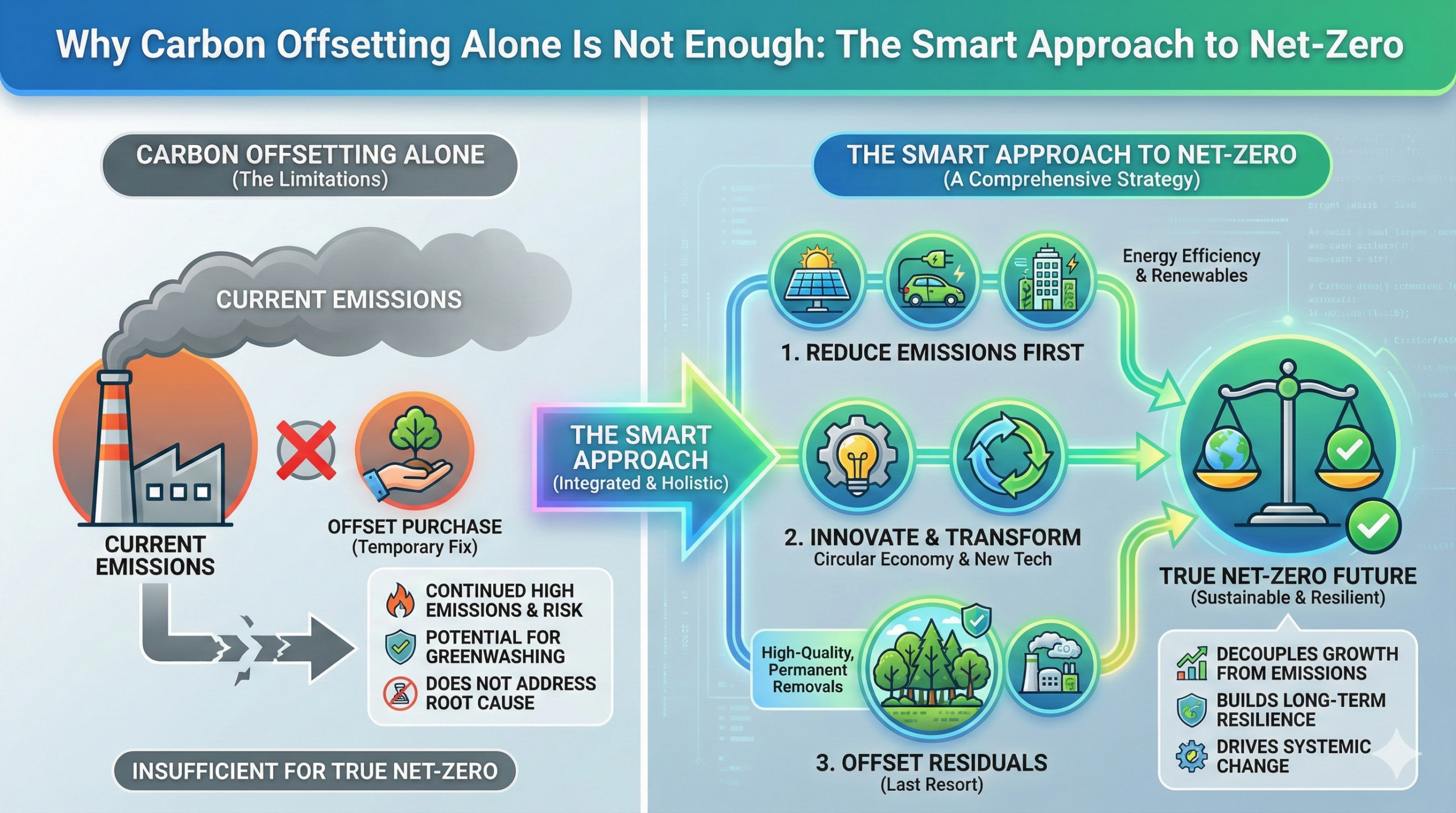
As climate commitments intensify across industries, many organizations have turned to carbon offsetting as a means of addressing their environmental impact. While offsetting plays a legitimate role in climate action, relying on it as a standalone strategy is no longer sufficient.
Stakeholders—including regulators, investors, and customers—now expect comprehensive, measurable, and transparent pathways toward net-zero emissions. Achieving true climate leadership requires more than compensating for emissions; it demands structural transformation.
This article explores why carbon offsetting alone falls short and outlines a smarter, integrated approach to achieving net-zero.
Understanding Carbon Offsetting
Carbon offsetting involves compensating for greenhouse gas emissions by investing in environmental projects that reduce or remove emissions elsewhere. These projects may include:
-
Reforestation and afforestation initiatives
-
Renewable energy installations
-
Methane capture programs
-
Carbon removal technologies
When verified under recognized standards, carbon offsets can contribute meaningfully to climate mitigation efforts. However, they address the symptom of emissions rather than the root cause.
Offsetting should serve as a complementary tool—not the foundation—of a net-zero strategy.
The Limitations of a Pure Offsetting Strategy
1. Lack of Structural Change
Offsetting does not inherently reduce a company’s operational emissions. Without internal reductions, businesses remain exposed to regulatory risks, carbon pricing mechanisms, and supply chain vulnerabilities.
2. Increasing Regulatory Scrutiny
Global regulators are tightening disclosure requirements and scrutinizing sustainability claims. Companies that rely heavily on offsets without demonstrating real emission reductions risk reputational damage and compliance challenges.
3. Greenwashing Concerns
Public awareness around environmental accountability has grown significantly. Stakeholders increasingly differentiate between genuine decarbonization efforts and superficial offset purchases.
Over-reliance on offsets can undermine credibility if not supported by transparent, measurable reductions.
4. Quality Variability in Carbon Credits
Not all carbon credits are equal. Concerns around additionality, permanence, and verification have led to greater demand for high-quality projects. Poor-quality offsets can weaken the legitimacy of corporate climate claims.
The Smart Approach: A Hierarchy of Climate Action
A credible net-zero pathway follows a structured hierarchy:
1. Measure Comprehensively
The first step is full visibility across Scope 1, Scope 2, and relevant Scope 3 emissions. Many companies underestimate value chain emissions, which often represent the largest share of their carbon footprint.
Accurate measurement establishes the foundation for targeted action.
2. Reduce Aggressively
Emission reduction must be prioritized over compensation. This includes:
-
Transitioning to renewable energy
-
Improving energy efficiency
-
Electrifying fleets
-
Optimizing logistics
-
Redesigning products for lower lifecycle emissions
-
Engaging suppliers in decarbonization efforts
Reduction strategies improve resilience while lowering long-term exposure to carbon-related financial risks.
3. Innovate and Transform
Beyond incremental reductions, companies should explore transformative changes:
-
Sustainable product redesign
-
Circular economy integration
-
Low-carbon material sourcing
-
Digital optimization for energy efficiency
Net-zero is not achieved through minor adjustments; it requires innovation embedded within corporate strategy.
4. Neutralize Residual Emissions
Only after meaningful reductions have been achieved should organizations neutralize unavoidable emissions through verified, high-integrity carbon removal solutions.
Priority should be given to projects that demonstrate:
-
Independent third-party verification
-
Long-term carbon storage permanence
-
Transparent monitoring and reporting
-
Alignment with international standards
Neutralization is the final step—not the starting point.
Net-Zero vs. Carbon Neutral: Understanding the Difference
Carbon neutrality often involves balancing emissions within a defined timeframe, sometimes relying heavily on offsets. Net-zero, however, requires deep and sustained emission reductions, with only residual emissions neutralized.
Net-zero commitments typically demand:
-
Science-based targets
-
Long-term decarbonization pathways
-
Transparent annual reporting
-
Clear differentiation between reductions and removals
As stakeholder expectations evolve, net-zero strategies are increasingly viewed as the gold standard of climate responsibility.
Strategic Benefits of a Comprehensive Approach
Organizations that move beyond offset-only strategies gain significant advantages:
-
Enhanced regulatory readiness
-
Stronger investor confidence
-
Reduced exposure to carbon pricing
-
Improved operational efficiency
-
Long-term cost predictability
-
Strengthened corporate reputation
Moreover, integrating decarbonization into core strategy fosters innovation and future-proofs business models against climate-related disruptions.
Building Credible Climate Leadership
True climate leadership requires alignment between ambition and action. Companies must demonstrate that:
-
Emissions are accurately measured
-
Reduction targets are science-based
-
Operational changes are implemented
-
Offsets are used responsibly and transparently
A balanced approach ensures environmental claims withstand regulatory scrutiny and stakeholder evaluation.
In today’s market environment, credibility is as important as commitment.